
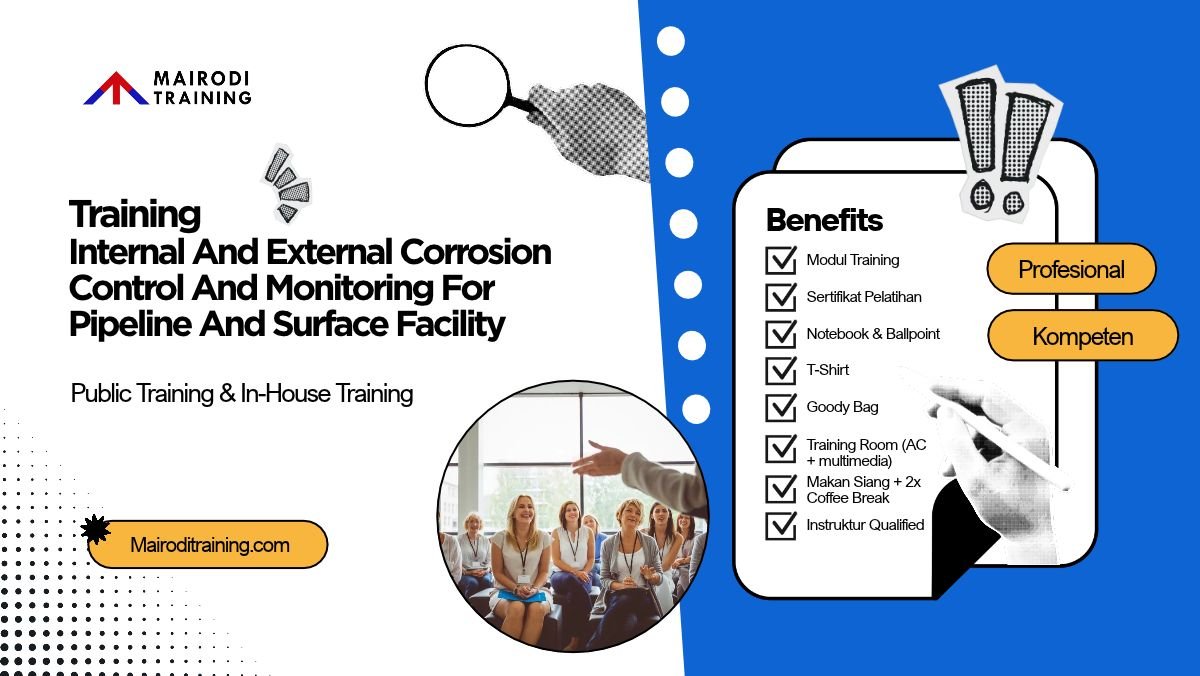
Training Internal and External Corrosion Control and Monitoring for Pipeline and Surface Facility adalah program pelatihan yang membahas metode pengendalian, pencegahan, serta pemantauan korosi internal dan eksternal pada jaringan pipa (pipeline) dan fasilitas permukaan (surface facility).
Pelatihan ini bertujuan meningkatkan pemahaman peserta mengenai mekanisme korosi, faktor penyebab kerusakan material, teknik inspeksi, serta penerapan metode perlindungan korosi yang tepat.
Peserta juga mempelajari penggunaan teknologi monitoring, evaluasi kondisi peralatan, dan strategi pemeliharaan untuk mengurangi risiko kebocoran, kerusakan fasilitas, serta gangguan operasional.
Pelatihan ini sangat relevan bagi tenaga profesional di industri minyak dan gas, petrokimia, serta sektor energi yang bertanggung jawab terhadap integritas aset, keselamatan kerja, dan keandalan fasilitas operasional.
Garis Besar Materi Training Internal And External Corrosion Control And Monitoring For Pipeline And Surface Facility
- Review of oil & gas surface production facility and operations.
- Review of metallic materials used in surface production facility and pipelines and the corrosion problem usually happen.
- Case studies and examples of oil & gas material failure caused by corrosion from internal and external source.
- Uniform, galvanic and localized corrosion failures.
- Internal corrosion of pipeline, vessel and processing equipment caused by sour component, H2S, CO2, organic acid, brine, and the SRB (sulfate reducing bacteria).
- External corrosion of underground, underwater and under-seawater pipeline and structure caused by impurities in soil and water environment.
- External corrosion of topside structure caused by marine atmosphere.
- Basic electrochemistry of corrosion process, Ohm’s law and the corrosion rate.
- Corrosion control and prevention with painting & coatings and the cathodic protection.
- Measurement of corrosion potential and corrosion current.
- Protection with sacrificial anode and impressed current.
- Understanding NACE Standard RP-01-69 to stop external corrosion attack.
- Requirement, design and criteria of cathodic protection.
- Sacrificial anode specification, installation and construction.
- Testing, monitoring, and inspection of cathodic protection.
- Inspection and maintenance of transformer-rectifier and sacrificial anode.
- Field test, measurement techniques and instrument.
- Data recording and evaluation of cathodic protection system.
- Case studies of corrosion control and prevention with cathodic protection.
- Internal corrosion problem in the pipeline and surface facility.
- Oil/gas/water fluid properties and the corrosion tendency.
- Deterioration by H2S, CO2, and acidic corrosive components.
- Pipeline leakage and rupture by microbial induced corrosion.
- Corrosion caused by SRB and the pitting mechanism.
- Corrosion caused by oxygen penetration.
- Examples and case studies of equipment corrosion damage and pipeline leakage.
- Understanding NACE Standard RP-0775 for internal corrosion control and monitoring.
- Practical internal corrosion monitoring methods.
- Access fittings, corrosion coupon and corrosion probes.
- Practical internal corrosion control and prevention methods.
- Internal corrosion control with inhibitors and the selection of suitable corrosion inhibiting chemicals.
- Dosage and injection methods of corrosion inhibitors.
- SRB control with biocides and the selection of suitable and low risk biocide formula.
- Dosage and injection methods of biocides.
- Oxygen control by de-aeration and chemical injection, and the selection of suitable oxygen scavenger chemicals.
- Dosage and injection methods of oxygen scavenger.
- Safety in the use of chemicals for internal corrosion prevention.
- Review of gas dehydration process and operations.
- Internal corrosion problem in glycol contactor (dehydration) unit.
- Method and materials use to control the corrosiveness of rich glycol solution.
- Review of amine sweetening process and operations.
- Internal corrosion problem in amine sweetening unit.
- Method and materials use to control the corrosiveness of rich amine solution.
- Examples and case studies of internal corrosion control
Siapa yang cocok mengikuti training?
- Anyone who needs to recognize corrosion and understand its devastating potential, especially as it relates to his or her area of responsibility, in oil and gas surface production facility and pipelines.
- Anyone involved in combating and controlling corrosion from internal and external source.
- Technicians and field operators and engineers of any discipline.
- Onshore / offshore facility and pipeline cathodic protection inspectors.
- Onshore / offshore structure painting and coating applicators and inspectors.
- Amine sweetening, glycol dehydration and gas processing plant operators.
- Beginners who interested in.
Tempat Training: Bandung, Jakarta, Yogyakarta
Durasi Training: 4 Days
Waktu Training Internal And External Corrosion Control And Monitoring For Pipeline And Surface Facility:
| Januari 2026 | Februari 2026 | Maret 2026 | April 2026 |
| 5 - 7 Januari 2026 | 2 - 4 Februari 2026 | 2 - 4 Maret 2026 | 6 - 8 April 2026 |
| 12 - 14 Januari 2026 | 9 - 11 Februari 2026 | 9 - 11 Maret 2026 | 13 - 15 April 2026 |
| 19 - 21 Januari 2026 | 18 - 20 Februari 2026 | 26 - 28 Maret 2026 | 20 - 22 April 2026 |
| 26 - 28 Januari 2026 | 23 - 25 Februari 2026 | 30 Mar – 1 Apr 2026 | 27 - 29 April 2026 |
| Mei 2026 | Juni 2026 | Juli 2026 | Agustus 2026 |
| 4 - 6 Mei 2026 | 2 - 4 Juni 2026 | 1 - 3 Juli 2026 | 3 - 5 Agustus 2026 |
| 11 - 13 Mei 2026 | 8 - 10 Juni 2026 | 6 - 8 Juli 2026 | 10 - 12 Agustus 2026 |
| 18 - 20 Mei 2026 | 17 - 19 Juni 2026 | 13 - 15 Juli 2026 | 19 - 21 Agustus 2026 |
| 22 - 24 Juni 2026 | 20 - 22 Juli 2026 | 26 - 28 Agustus 2026 | |
| 27 - 29 Juli 2026 | |||
| September 2026 | Oktober 2026 | November 2026 | Desember 2026 |
| 1 - 3 September 2026 | 5 - 7 Oktober 2026 | 2 - 4 November 2026 | 1 - 3 Desember 2026 |
| 7 - 9 September 2026 | 12 - 14 Oktober 2026 | 9 - 11 November 2026 | 7 - 9 Desember 2026 |
| 14 - 16 September 2026 | 19 - 21 Oktober 2026 | 16 - 18 November 2026 | 14 - 16 Desember 2026 |
| 21 - 23 September 2026 | 26 - 28 Oktober 2026 | 23 - 25 November 2026 | 21 - 23 Desember 2026 |
| 28 - 30 September 2026 | 28 - 30 Desember 2026 |
Biaya Investasi/Peserta:
- Rp 8.950.000/person (full fare) or
- Rp 8.750.000/person (early bird, payment 1 week before training) or
- Rp 8.500.000/person (if there are 3 or more participants from the same company)
Fasilitas Untuk Peserta Training:
- Training Module
- Certificate
- Stationeries: NoteBook and Ballpoint
- T-Shirt
- Goody Bag
- Training Photo
- Training room with full AC facilities and multimedia
- Lunch and twice coffeebreak everyday of training
- Qualified instructor
Tingkatkan Keandalan Pipeline dan Surface Facility melalui Pengendalian Korosi
Korosi pada jaringan pipa dan fasilitas permukaan dapat menyebabkan kebocoran, kerusakan aset, hingga gangguan operasional yang merugikan perusahaan.
Oleh karena itu, pemahaman mengenai pengendalian dan pemantauan korosi internal maupun eksternal menjadi hal penting bagi tenaga profesional di industri minyak dan gas serta sektor energi.
Training Internal And External Corrosion Control And Monitoring For Pipeline And Surface Facility dari Mairodi Training hadir untuk membantu peserta memahami teknik inspeksi, metode pencegahan korosi, serta strategi monitoring guna menjaga integritas dan keandalan fasilitas.
Selain itu, pemahaman terkait Training Industrial Metrology juga dapat mendukung ketelitian pengukuran dalam proses inspeksi dan pengendalian kualitas.
Melalui pelatihan ini, peserta diharapkan mampu menerapkan praktik pengendalian korosi secara efektif demi meningkatkan keselamatan dan efisiensi operasional perusahaan.